Aspen RN-to-BSN Community Health Field Experience
Aspen University’s RN-to-BSN field experience is community and public-health work, not hospital clinical rotations, and it does not require a preceptor. Here is exactly how the field hours are structured, what counts, and how we help you find and document a placement.
What the RN-to-BSN field experience actually is
If you are coming into Aspen University’s RN-to-BSN program from an associate degree or diploma, the “field experience” can sound like the clinical rotations you remember from your original nursing education. It is not. The RN-to-BSN field work is community-health and public-health field experience, population-focused activities such as community assessment, health promotion, and nursing leadership projects. It is fieldwork you complete in a community setting, documented and approved as part of your coursework, rather than supervised hospital shifts at the bedside.
Importantly, the RN-to-BSN field experience does not require a preceptor. That is a meaningful difference from Aspen’s graduate nursing programs. The MSN and DNP each require a qualified preceptor and an approved practicum or immersion site; the RN-to-BSN does not. Your hours are documented and approved before you complete the relevant courses, but you are not matched to a master’s-prepared preceptor the way an MSN student is.
This page focuses only on the BSN-completion field experience. If you are looking at a graduate path instead, see our overview of Aspen nursing programs, the RN-to-MSN bridge, or the DNP immersion requirements, each of which has its own preceptor and site rules.
The field hours: N492, N493, and N496
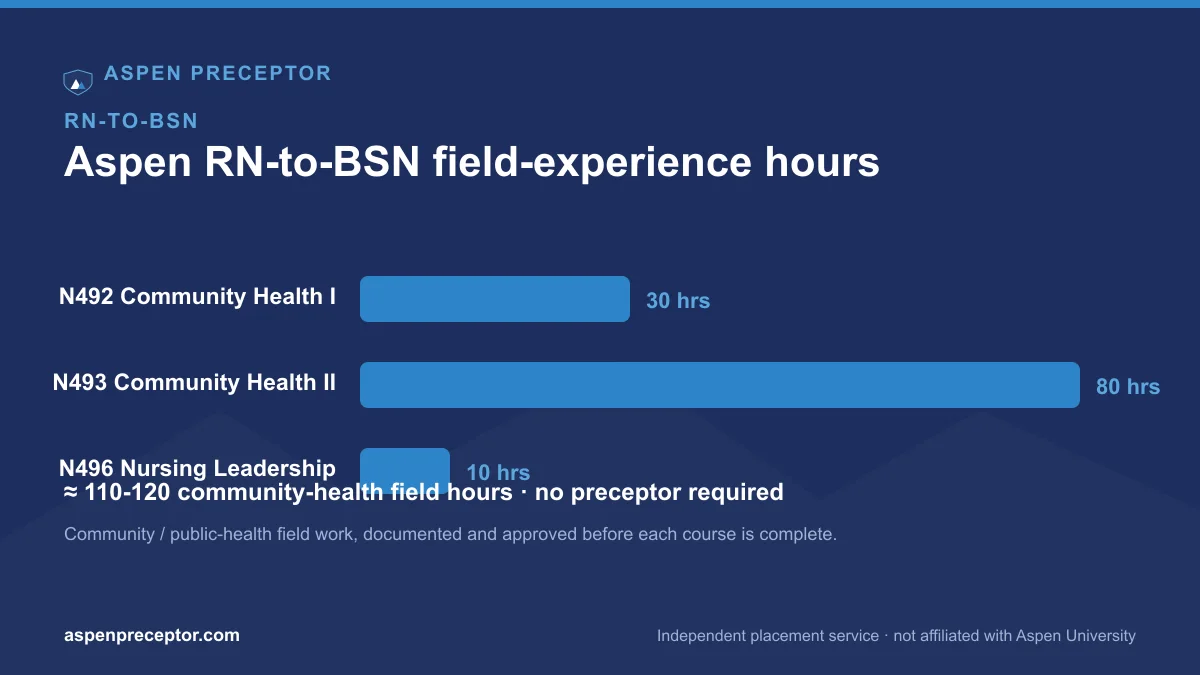
Across the RN-to-BSN program, the community-health field experience totals roughly 110 to 120 hours, spread across three courses. The hours are concrete and tied to specific coursework rather than a single block of rotation time:
Because these are community-health and leadership field hours, the settings differ from clinical rotations. The work centers on community and public-health activity, assessing a population’s health needs, planning and delivering health-promotion or education efforts, and completing a nursing-leadership component, rather than direct patient-care shifts in an acute hospital unit. Many RN-to-BSN students complete this work in or around their own community and current workplace.
The hours are documented and approved before you finish the course. That means keeping clear records of where you went, what you did, and how many hours each activity took, then having that field experience reviewed and signed off through your coursework. Getting the documentation right the first time is the difference between finishing on schedule and scrambling at the end of a term.
How the field hours break down
- N492 Community Health I, 30 field hours
- N493 Community Health II, 80 field hours
- N496 Nursing Leadership, 10 field hours
How this differs from Aspen’s graduate practicums
It is worth being precise, because students mix these up constantly. The RN-to-BSN field experience is community/public-health field work with no preceptor requirement. By contrast, Aspen’s MSN specializations, Forensic Nursing, Informatics, Administration & Management, Nursing Education, and Public Health, each require a 120-hour practicum with a qualified preceptor, and the DNP requires 1,000 clinical-practice immersion hours plus a clinical site and preceptor.
So if you are completing your BSN, you do not need to spend months hunting for a master’s-prepared preceptor. What you do need is a suitable community-health placement and clean, approved documentation of your hours. Those are different problems, and the second one is where students most often stumble.
Where we fit in, and how we help
We are aspenpreceptor.com, an independent service. We are not affiliated with, endorsed by, or partnered with Aspen University, and we are not its Office of Field Experience. We are a private service that helps Aspen nursing students move through field-experience and practicum requirements faster, with less frustration.
For RN-to-BSN students specifically, we help you find a suitable community-health field placement, a setting where you can carry out the population-focused and leadership work N492, N493, and N496 call for, and we help you keep that field experience documented and ready for approval so nothing stalls your term. We can also walk you through what to record, how to organize your hours, and what your courses expect of you. (If you later move into a graduate program, our find-a-preceptor service and practicum hours and approval guidance carry over.)
We assist; we never guarantee placement, and we are honest about that. If you want help getting your community-health field hours lined up and documented, tell us about your situation, and you only pay when matched to a placement that fits your program.
Frequently asked questions
Does Aspen’s RN-to-BSN require a preceptor?
No. The RN-to-BSN community-health field experience does not require a preceptor. That requirement applies to Aspen’s graduate programs, the MSN practicum and the DNP immersion, not to the BSN-completion field work.
How many field hours does the Aspen RN-to-BSN require?
Roughly 110 to 120 community-health field hours across three courses: N492 Community Health I (30 hours), N493 Community Health II (80 hours), and N496 Nursing Leadership (10 hours).
Are these hospital clinical rotations?
No. The RN-to-BSN field experience is community and public-health field work, population assessment, health promotion, and a nursing-leadership component, not supervised hospital clinical rotations or direct patient-care shifts.
Can I do the field experience near my workplace?
Many RN-to-BSN students complete this community-health work in or around their own community and current workplace. The key requirement is that the hours are documented and approved before you complete the relevant courses.
Are you part of Aspen University?
No. aspenpreceptor.com is an independent service. We are not affiliated with, endorsed by, or partnered with Aspen University, and we are not its Office of Field Experience. We help students find and document field placements, and you pay only when matched.
Get your Aspen practicum handled.
Tell us your program and specialty. We’ll map your field-experience requirement and start the search, in person or virtual. No payment until you’re matched.